

Quick Takeaways
- Allegro announced a 48V power-management IC, inductive position sensors, and TMR and Hall-effect angle-sensing options for robotics on October 20, 2026.
- The A81481 combines dual buck regulators, five LDO outputs, and safety diagnostics for 48V robotic power architectures, according to Allegro.
- The A17802 and A17803 inductive sensors target high-torque joints, while the CT310 and A33023 target compact joint and angle-feedback applications.
- Buyers evaluating robotic actuators can compare the electrical architecture, feedback technology, package constraints, diagnostic needs, and evaluation support for their intended joint design.
Industry Update
Allegro MicroSystems announced a set of power-management and sensing components aimed at physical-AI and humanoid-robot designs. The company said the portfolio addresses torque density, thermal management, and functional-safety challenges that arise when many actuated joints must fit into constrained mechanical envelopes.
The A81481 is described as a single-chip 48V power-management IC for safety-critical robotics. Allegro says it integrates dual buck regulators, five low-dropout outputs, and diagnostics including a triple-watchdog architecture, allowing remote sensing clusters to be powered from a 48V bus without external pre-regulators.
For position feedback, Allegro named A17802 and A17803 inductive sensors for high-torque joints such as shoulder, hip, and knee actuators. Its CT310 TMR sensor and A33023 Hall-effect angle sensor are positioned for tighter robotic-hand and finger mechanisms. The company says the sensing options are designed to tolerate factors such as air-gap variation, contamination, shock, or runout, depending on the device.
Allegro also cited a collaboration with Sarcomere Dynamics, which is integrating Allegro motion controllers, sensors, and power ICs into its Scorpion gripper and plans to extend the work to a robotic hand program.
Buyer Considerations
For an OEM or integrator, the announcement is a useful reminder to evaluate actuator electronics as a combined motor, drive, power-distribution, and feedback system. A 48V architecture can change cable sizing, local voltage conversion, thermal design, protection strategy, and serviceability; those tradeoffs need checking at the robot or machine level.
Position-sensor selection should begin with the required joint range, speed, feedback resolution, mechanical air gap, electromagnetic environment, and safety concept. Inductive, TMR, and Hall-effect sensing technologies have different integration and qualification considerations, so a component announcement alone is not a substitute for application testing.
Teams should also confirm device availability, package options, operating conditions, diagnostics behavior, and software or evaluation-board support directly with the supplier before committing an actuator design. For multi-axis platforms, it is especially useful to identify whether common power and feedback interfaces can be maintained across joint sizes.
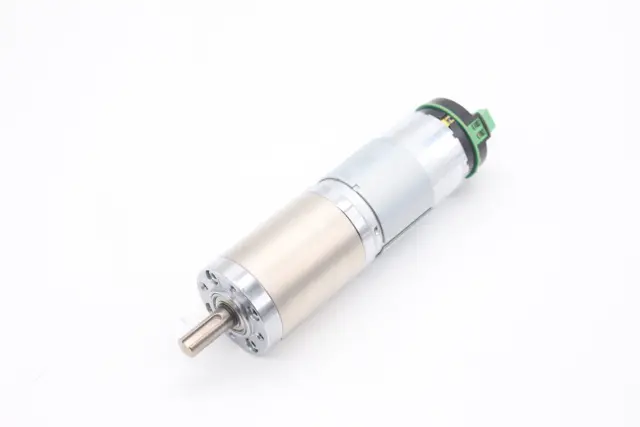
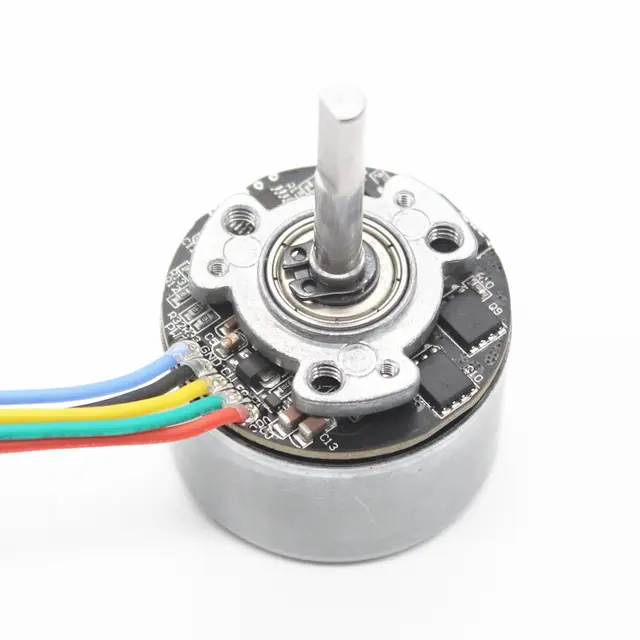
Motor series to compare for this kind of project.
Frequently Asked Questions
What did Allegro announce for robotics?
Allegro announced a 48V power-management IC plus inductive, TMR, and Hall-effect position-sensing options intended for robotic power and joint-feedback designs.
Which robotic applications are mentioned in the announcement?
Allegro discusses high-torque joints such as shoulder, hip, and knee actuators, along with compact robotic hands and fingers.
Does this announcement specify a complete robotic motor system?
No. It describes power-management and sensing building blocks. Motor, drive, mechanics, controls, and safety validation still need to be matched to the application.
What should buyers check before adopting these components?
Check the electrical architecture, sensor fit, package and thermal constraints, diagnostic requirements, availability, and supplier evaluation support for the intended actuator design.
Source
This article summarizes publicly available source information. Confirm technical details, pricing and compliance requirements with the original source before making purchasing decisions.
Source date: 2026-10-21